Quantum computers are real, even if their appearance still seems borrowed from science fiction. They use quantum states to process information in ways that ordinary digital computers cannot directly reproduce. That creates exciting research possibilities, but does not mean a quantum machine is a faster replacement for every laptop, database or game console.
The useful starting point is to understand what qubits and measurements do, which problems have suitable algorithms, and why reliable hardware remains difficult. This guide separates those ideas from the claim that a quantum computer simply tries every answer and prints the best one.
From Classical Bits to Qubits
A classical bit has two possible values, 0 and 1. Three bits have eight possible binary patterns, from 000 to 111; a particular classical register holds one pattern at a time. It is therefore incorrect to say that n classical bits have only n possible states. Their possible patterns also number 2^n.
A qubit is a quantum system with two chosen basis states, conventionally written |0⟩ and |1⟩. Its state can be a superposition described by complex amplitudes for these possibilities. Amplitudes determine outcome probabilities when measured in that basis; they are not two ordinary stored bits that can both be read out.
With several qubits, the joint state can involve amplitudes for many binary outcomes. The large mathematical description matters, but a measurement does not reveal the entire list. Quantum algorithms must arrange operations so that the information needed for the task can be extracted. More qubits alone do not guarantee a useful speed improvement.
Superposition, Entanglement and Interference
Superposition describes a combination of quantum basis states. The familiar light-switch analogy helps introduce the idea, but has a limit: measuring a qubit in the computational basis gives one classical result, not a display reading “0 and 1.” Repeatedly preparing and measuring the same circuit lets us estimate the distribution of outcomes.
Entanglement concerns the joint state of multiple systems. An entangled state cannot be described as independent states for each part, and measurements can show correlations unavailable to a classical local model. This is not a controllable signal that lets one person send an instantaneous message to another. The original phrase “whatever happens to one instantly affects the other” is too broad for explaining communication.
Interference allows amplitudes to reinforce or cancel through appropriately chosen operations. It is central to quantum algorithms, but does not make every wrong answer disappear with nearly 100% certainty. Success probability and the number of repetitions depend on the algorithm and hardware.
A beginner circuit illustrates the process: prepare qubits in a known state, apply gates, measure and collect results over multiple shots. IBM's first-program lesson uses a Hadamard gate and controlled-NOT to prepare a two-qubit Bell state. In an ideal computational-basis measurement, it gives 00 or 11 with equal probability. Those are theoretical outcomes, not measurements made for this article; real hardware can produce other results because of errors.
Compare the Jobs, Not Just the Headline Numbers
| Question | Classical computing | Quantum computing |
|---|---|---|
| What information is processed? | Classical values represented by bits. | Quantum states manipulated with operations and measurements. |
| What does a program return? | Results produced by its classical algorithm. | Measured results that usually need classical processing and statistical interpretation. |
| Where is it useful? | Everyday applications and established numerical methods. | Problems with suitable quantum algorithms; advantage must be demonstrated for the task. |
| How should performance be judged? | Time, resources, accuracy and workload. | The same useful result, including preparation, repetitions, errors and classical overhead. |
A meaningful comparison includes the best relevant classical method, not just a deliberately inefficient brute-force baseline. Loading data, compiling circuits, waiting for hardware and processing results can matter as much as execution time. A claim of advantage for one experiment does not establish faster financial modelling, logistics or machine learning in general.
What the Hardware Looks Like
The chandelier-like equipment often seen in photographs belongs to the cooling and control infrastructure around superconducting quantum processors. The small processing chip is only one part of the complete machine. Control wiring, electronics and cryogenic stages support its operation; the photograph is not a picture of hundreds of visible qubits.
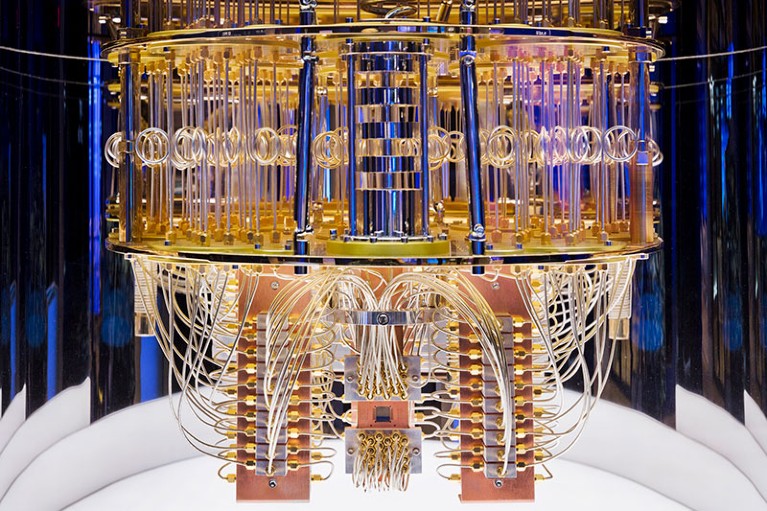
The original Eagle caption is historical rather than a current hardware ranking. IBM's 16 November 2021 announcement describes Eagle as its first deployed processor with more than 100 operational, connected qubits. That is an IBM milestone, not a claim that no other quantum architecture previously reached any larger numerical count.
Other approaches have different requirements. IonQ's trapped-ion description explains ions held in electromagnetic traps inside a high-vacuum chamber, with lasers used for cooling, preparation, gates and readout. It cools the ions without refrigerating all supporting hardware. Thus, not every quantum computer requires the same dilution refrigerator or a universal 15 millikelvin operating temperature.
Neutral-atom and photonic approaches further broaden the field. Their components and control requirements differ, so avoid drawing a universal conclusion about size, cost or room-temperature operation from one photograph. Architecture comparisons should use documented device capabilities and the application being studied.
What Shor's and Grover's Algorithms Actually Promise
Shor's algorithm gives efficient quantum methods for integer factorisation and discrete logarithms. RSA relies on the former kind of problem; elliptic-curve cryptography involves a discrete-logarithm problem, rather than prime factorisation. The cryptographic concern is a sufficiently capable, reliable quantum computer running the required computation, not the mere existence of a small processor.
Grover's search algorithm offers a quadratic query improvement for an unstructured search problem. That does not make every database query faster: data access and the implementation of the condition being searched matter. Nor does it produce Shor's type of speedup for every hard problem.
For symmetric encryption, the slogan “AES-128 becomes 64-bit security” leaves out important practical costs. NIST's FAQ explains the constraints of serial quantum search and parallel classical attacks, and says current applications can continue using AES with 128-, 192- or 256-bit keys under its guidance. Do not confuse the public-key migration with a claim that today's AES deployments have already been broken.
Experimenting from an Ordinary Computer
You can learn circuit concepts without owning a physical quantum processor. IBM Quantum Composer provides a visual circuit interface, while Qiskit supports programming. A local simulator runs on a classical computer: it is useful for small examples and checking expected behaviour, but is not evidence of a physical quantum speedup.
Cloud access offers a different route. Amazon Braket describes submitting tasks to supported simulators or QPUs and retrieving results. Its device list and available methods should be checked when choosing an experiment. Provider, account, region, queue and execution terms can change, so avoid assuming every advertised device is available to every account without cost.
A sensible learning exercise is to predict a small circuit's outcomes, compare an ideal simulation and then examine documented hardware results. Label each clearly and record shots, circuit and device. Keep cloud credentials private and understand billing before submitting repeated jobs. This article does not report an executed QPU experiment.
Errors, Progress and Post-Quantum Security
Physical qubits are susceptible to errors in gates, storage and readout. A logical qubit encodes information across physical resources so errors can be detected or corrected using an appropriate code. A physical-qubit total is therefore not interchangeable with a count of reliable logical qubits. The code, operations and achievable error rates matter.
Error mitigation is also distinct from full fault tolerance. It aims to improve estimates from noisy computations, often using extra measurements and classical processing, rather than guaranteeing correction of the quantum state during every operation. Read an experiment's method before treating its headline as a general reliability result.
In July 2026, IBM and collaborators reported demonstrations of quantum advantage with validation methods. IBM also describes continuing comparison against classical approaches. These are specific research results, not proof that ordinary computers have become obsolete or that large-scale cryptographic attacks are routine.
Preparing for the security risk is still worthwhile because important data can remain confidential for years. NIST describes “harvest now, decrypt later” as capturing encrypted material for a potential future attack. Post-quantum cryptography uses algorithms intended to resist relevant quantum attacks while running on conventional systems; it does not require buying a quantum computer.
NIST approved FIPS 203, 204 and 205 in August 2024: ML-KEM for key establishment, ML-DSA for lattice-based signatures and SLH-DSA for hash-based signatures. For your services, inventory protocols and dependencies, follow supported vendor migration guidance and test compatibility. A familiar VPN or browser name alone does not establish that a particular installed version and connection uses post-quantum protection.
A Different Tool, with Real Potential
Quantum computing adds an important way to study selected problems, while classical systems continue to handle daily computing and much of the surrounding workflow. You can explore its ideas from a normal laptop through learning tools, simulators and supported cloud services. When reading the next breakthrough headline, check the task, accuracy, resources and classical comparison. Those details reveal far more than an impressive qubit count or a promise to solve every difficult problem.