The artificial intelligence landscape is set for another seismic shift. On June 30, 2025, Chinese tech giant Baidu released the ERNIE 4.5 model family and development tools under Apache 2.0. That is the release discussed here; it does not mean the entire hosted ERNIE Bot service, its infrastructure or every later ERNIE model has been opened. For those outside the immediate tech circle, this might sound like just another headline in a sea of AI news. But make no mistake, this is a story worthy of your attention.
Remember the shockwaves sent through the markets when DeepSeek, another formidable Chinese AI, was open-sourced/released? The sudden availability of a high-performance, open-source model caused a significant stir, challenging the dominance of established, proprietary players. With Baidu's ERNIE 4.5 entering the open-model arena, I see the potential for another major disruption. That is an expectation about the opportunity, rather than a claim that the release has already reproduced DeepSeek's market impact.
What is ERNIE Bot and Why is This a Big Deal?
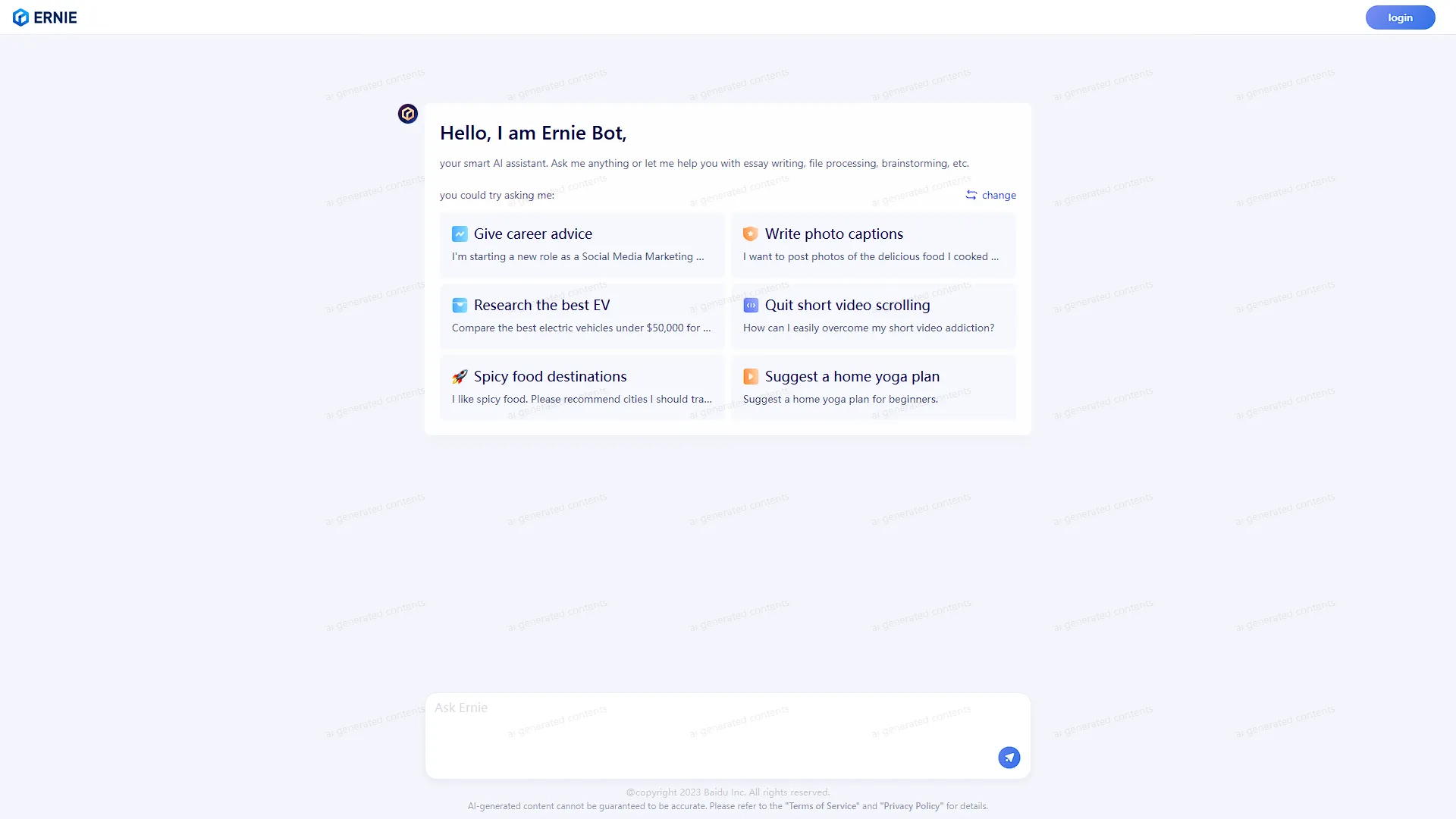
ERNIE, which stands for "Enhanced Representation through Knowledge Integration," is Baidu's flagship AI model. The name refers to a model family, while ERNIE Bot is the conversational product built around it. Released ERNIE 4.5 language models produce text; its vision-language variants accept text, images and video and also produce text. Reading an image is different from generating a new image. It's the engine behind Baidu's popular chatbot and a direct competitor to the likes of OpenAI's ChatGPT and Google's Gemini.
Baidu's hosted chatbot and earlier ERNIE research should not be treated as one licensing category. The useful change in this release is access to ERNIE 4.5 checkpoints and supporting code, allowing developers, researchers and hobbyists to inspect, adapt and deploy those models subject to the licence. It is not the same as receiving every training dataset or a ready-made copy of Baidu's consumer service.
This is a big deal for several reasons:
- Innovation Unleashed: When a powerful tool is made available to everyone, the pace of innovation accelerates dramatically. There is room for new applications and services built on these models, though their success still depends on useful products, deployment costs and testing.
- Increased Competition: The dominance of a few major players is being challenged. Open-source models level the playing field, fostering a more competitive and, ultimately, more consumer-friendly market.
- Transparency and Trust: Published weights and code allow more scrutiny and independent evaluation. They do not automatically disclose all training data, remove bias or make a deployed application secure.
How Does ERNIE Stack Up Against the Titans?
The LLM space is crowded with heavyweights. So, how does ERNIE Bot compare to the models you might be more familiar with?
- DeepSeek: DeepSeek made a name for itself with its impressive performance and cost-effectiveness. Its releases highlighted the competitive possibilities of shared model weights. That does not mean training or operating a powerful model requires little funding or hardware. ERNIE's open-sourcing is a direct continuation of this trend, but from a much larger and more established player.
- OpenAI's GPT Series: OpenAI's models, like GPT-3 and GPT-4, have been the trailblazers in the recent AI boom. They are known for their strong conversational abilities and a vast general knowledge base. While ERNIE is a formidable competitor, especially in its understanding of Chinese language and culture, OpenAI has a significant head start in the global market.
- Google's Gemini: As a mature and deeply integrated LLM, I regard Gemini as a strong example of the convenience a mature hosted AI product can offer. The practical comparison is between specific model versions and the tools available around them, rather than a permanent ranking of whole brands.
The Power of Maturity: Why Gemini Still Holds an Edge
While the ERNIE 4.5 release is exciting, my preference for Gemini's mature product experience still has a place in this comparison. The development of a useful and reliable AI service is a marathon, not a sprint. A convenient hosted service and adaptable local weights solve different problems.
Years of research, development, and real-world application have gone into refining Gemini. This maturity translates into:
- Greater Reliability and Safety: I value a service with clear safeguards and ongoing testing. Closed licensing alone is not evidence that a model is safer, less biased or more accurate; those qualities need evaluation for the version and task involved.
- Seamless Integration: A polished interface and integration with existing tools can matter more to a user than the ability to modify weights. Recreating that complete experience locally requires additional application work, not just downloading a checkpoint.
- Cutting-Edge Performance: Continued development is valuable, but it does not settle every comparison. Use the same tasks, input files and scoring rules when deciding whether a particular hosted or local model meets your needs.
What to Expect Now That ERNIE is in the Wild
The ERNIE 4.5 model release creates several possibilities:
- A Price War: The availability of powerful, free, open-source models may put pressure on hosted services to become more competitively priced. Free weights do not make electricity, GPUs or administration free.
- A Surge in Customization: Businesses and developers will be able to fine-tune ERNIE for specific tasks and industries, leading to a new wave of specialized AI solutions.
- New Ethical Considerations: The widespread availability of powerful AI tools also raises important questions about responsible use and the potential for misuse. The open-source community and a wider range of stakeholders will now have a role to play in addressing these challenges.
Inside the ERNIE 4.5 Release
The initial family contains ten variants: base and post-trained versions of five model sizes. Base checkpoints target further training; post-trained versions are the more natural starting point for following conversational instructions. Later Thinking releases and new framework conversions should not be confused with the exact launch-day set.
| Family | Total parameters | Active parameters per token | Input and output |
|---|---|---|---|
| ERNIE 4.5 0.3B | 0.3 billion, dense | 0.3 billion | Text in; text out |
| ERNIE 4.5 21B-A3B | 21 billion, MoE | 3 billion | Text in; text out |
| ERNIE 4.5 VL 28B-A3B | 28 billion, MoE | 3 billion | Text/image/video in; text out |
| ERNIE 4.5 300B-A47B | 300 billion, MoE | 47 billion | Text in; text out |
| ERNIE 4.5 VL 424B-A47B | 424 billion, MoE | 47 billion | Text/image/video in; text out |
Apache 2.0 permits commercial use subject to its conditions; preserve required notices and check the licence of any additional dataset or component. “Open weights” accurately describes the downloadable checkpoints. Baidu also publishes development code, but that does not establish access to every ingredient needed to reproduce its original training.
Understanding MoE and Hardware Requirements
A mixture-of-experts model routes a token through a subset of its experts. Baidu describes modality-specific routing and shared parameters in its heterogeneous multimodal design. This can reduce the active computation relative to a dense model of the same total size; it does not mean only the active parameters need storage.
For example, a rough weight-only calculation for 21 billion parameters at two bytes each is 42 GB in decimal units. The inference engine, activations, key/value cache and concurrent requests need additional memory. Quantization and CPU offloading alter that calculation, along with speed and possible quality tradeoffs. A claim that the unquantized model simply fits any 8–16 GB GPU is therefore misleading.
Baidu reports specialised low-bit quantization results, including techniques described as lossless in its experiments. Treat those as results of particular methods and evaluation conditions, not a promise that arbitrary two-bit conversions preserve every answer. Check the exact checkpoint format, backend, GPU support and context settings before downloading large files.
A Local vLLM Starting Point
The current PyTorch model card and vLLM support list include baidu/ERNIE-4.5-21B-A3B-PT. The card specifies vLLM 0.10.2 or newer while excluding 0.11.0; confirm compatibility with the particular installed release. That current support is different from claiming every framework was ready on launch day.
After installing a compatible GPU runtime and confirming sufficient memory, this starts a localhost-only API with a deliberately reduced context limit. It is an illustrative starting configuration, not a tested hardware recommendation:
vllm serve baidu/ERNIE-4.5-21B-A3B-PT \
  --host 127.0.0.1 \
  --port 8000 \
  --max-model-len 8192
The checkpoint card lists a maximum context of 131072 tokens, but a model's supported maximum does not mean your machine can serve it at that length. A lower configured limit helps control cache demands; it does not solve insufficient weight memory. Keep the endpoint private, control access if you later put a proxy in front, and avoid enabling remote-code execution flags unless the selected model actually requires reviewed code.
Evaluate It for Your Own Work
Use a small set of representative, non-sensitive tasks: summarise a document with a known answer, extract fields from a table, explain a piece of code and handle a question where information is missing. Record the checkpoint, quantization, prompt and context setting so comparisons are reproducible. For a VL model, include actual image or document inputs rather than assuming a text-only model can see them.
Compare factual accuracy, refusal or uncertainty behaviour, output format and running costs. A benchmark reported by the developer is useful context, but it is not our own hands-on measurement or proof of superiority for your workflow. Local deployment can give control over processing, yet prompts can still leave the machine through connected tools, telemetry or a separately configured API.
Conclusion: A New Chapter in the AI Story
The decision by Baidu to release ERNIE 4.5 openly is a landmark moment in the ongoing evolution of artificial intelligence. I see it as a move that can widen access to powerful AI tools, encourage innovation and add competition.
While the immediate "shock" may be reminiscent of DeepSeek's debut, the long-term implications of a tech giant like Baidu embracing the open-source philosophy are far more profound. As we celebrate the new possibilities this unlocks, I also appreciate the value of polished services such as Google's Gemini. That preference is about the overall experience, rather than a verified universal safety or performance ranking. The future of AI is not a zero-sum game; it's a collaborative and increasingly open ecosystem where both proprietary and open-source models will play a vital role in shaping our world. The floodgates are open, and the tide of innovation is rising.